
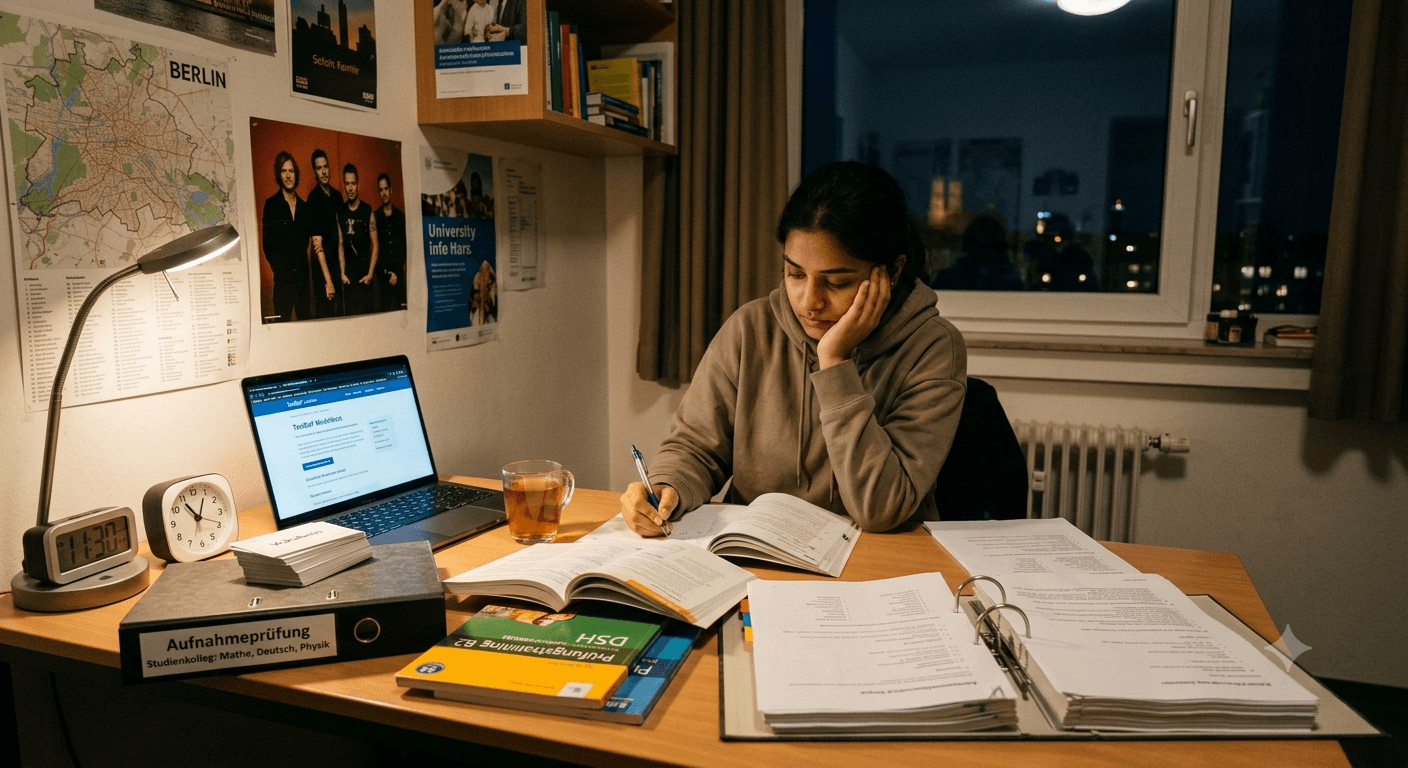
Most study plans look like calendars. They tell you what to do at 9am Monday and forget that your brain is the thing you are training. A plan built from the actual research on sleep, retrieval, and focus looks different — it has fewer hours per day, more breaks, and treats the night after a hard study day as the hardest-working hour of the schedule. This post is the hub for the whole series. We’ll walk through a 30-, 60-, or 90-day prep window for exams like TestAS, the Leuphana Studierfähigkeitstest, Deltaprüfung, KL Krems or HSG St. Gallen, and link out to the protocols that make each phase work.
Why the typical study plan misses the point
Most plans handed out by tutors or „lerncoaches“ are a list of topics divided by the number of weeks until the exam. They look orderly. They miss two of the three things that decide whether you actually remember anything: how you encode the material in the room, and what your brain does with it overnight.
The neuroscience consensus is unusually tidy on this. During focused effort the brain tags synapses that might matter. The actual rewriting — long-term potentiation and pruning — happens during deep NREM and REM sleep that night. Matt Walker, the UC Berkeley sleep researcher, puts it directly: „practice does not make perfect; practice with sleep makes perfect“ (Walker, Why We Sleep, 2017). If your plan doesn’t protect sleep, it’s protecting nothing.
The third missing piece is retrieval. Roediger and Karpicke’s 2006 test-enhanced learning study in Psychological Science showed that one self-test reduces forgetting by roughly half on a delayed exam. Re-reading the same chapter twice does not. Most students don’t know this; they spend their planned hours re-reading and feel productive while the material slides out of their head over the next ten days.
So the plan we’ll build below has three non-negotiables: focused effort with friction, retrieval over re-reading, and protected sleep. Everything else — Pomodoro timers, colour-coded notes, motivational playlists — is optional.
The four building blocks neuroscience actually supports
Strip away the listicles and only four ingredients reliably move the needle.
1. Active recall. Closed-book retrieval beats every other study method that has been tested at scale (Karpicke & Blunt, Science, 2011). We use it as the spine of every study session — the chapter ends with you writing down what you remember, not with another highlighter pass.
2. Spaced repetition. Cepeda and colleagues‘ 2006 meta-analysis synthesised 839 assessments from 317 experiments; distributed practice reliably beat massed practice across them. For vocabulary and concepts, expanding intervals (1 day, 3 days, 7 days, 14 days, 30 days) are the gold standard. We use spaced repetition with Anki to automate the schedule.
3. The 90-minute focus block. The brain runs a ~90-minute basic rest-activity cycle, first described by Nathaniel Kleitman at Chicago. Cal Newport (Georgetown, Deep Work) and the cognitive-performance literature converge on two to three of these blocks per day as the upper limit for high-quality output.
4. Sleep + NSDR. Sleep is when the encoding becomes durable memory. NSDR — non-sleep deep rest, a 10-20 minute supine practice — partially mimics the consolidation state in a Kjaer et al. 2002 Cognitive Brain Research PET study that showed a ~65% rise in striatal dopamine after a single hour of yoga nidra. Use NSDR in the gap between blocks.
The rest of the plan is just choreography around these four.
Day-shape: what a single training day looks like
A model day for a gap-year student preparing for TestAS or the Leuphana SFT:
- 07:00 wake at a consistent time (±30 minutes, including weekends)
- 07:05 outside for 10 minutes of morning sunlight — no sunglasses, no window glass
- 07:30 light breakfast, water
- 08:30 first coffee (90-120 minutes after waking)
- 09:00-10:30 Block 1: hardest material, closed-book retrieval at the end
- 10:30-11:00 10-minute walk outside, no phone; then 20 minutes NSDR
- 11:00-12:30 Block 2: second-hardest material, ends with retrieval
- 12:30-13:30 lunch, walk
- 13:30-14:00 NSDR
- 14:00-15:00 Anki review (spaced repetition) plus one past-paper section
- 15:30-16:30 cardio (Zone 2, 30-45 minutes) — Suzuki’s protocol for memory and mood
- 17:00 onwards: dinner, family time, light reading. No new material.
- 21:30 phone out of the bedroom; lights low
- 22:00 lights out
Two 90-minute blocks. One easier afternoon session. One Anki round. One cardio block. That’s a full training day. It looks lighter than what you imagined a „serious“ prep schedule should be. That’s the point. Quality over volume, with the night after carrying the weight.
One underrated point: the night AFTER a hard study day matters more than any other in your schedule. Walker calls this the first-night effect. Skip sleep that night and you’ve thrown away the work, even if you sleep fine on the following nights.
The 90-day plan (gap-year version)
Most edulink readers are on a gap year. That gives you the luxury of months — and the trap of months. Without school structure, the days blend into each other and motivation drifts. The 90-day plan trades intensity for sustainability.
Days 1-30: Foundation phase.
- Week 1: regularise sleep. Pick a bedtime, hold it ±30 minutes every night. Take one full past paper under exam conditions on day 5 or 6 — this is your diagnostic, not a learning session.
- Weeks 2-4: install the day-shape above. Build Anki decks for the highest-weighted topics. End every chapter with closed-book retrieval. One past-paper section per week.
- Cardio: 30-45 minutes, three to four times per week.
- Phone rule: in another room during each block. Non-negotiable. The Ward et al. 2017 Journal of the Association for Consumer Research „brain drain“ study showed that even a face-down silent phone reduces working memory.
Days 31-60: Build phase.
- Two 90-minute blocks per day, hardest content first.
- Switch from blocked practice to interleaving — alternate related-but-distinct topics within a block. Rohrer & Taylor’s „desirable difficulties“ research shows interleaved practice produces lower in-session performance but much higher retention on the test.
- One past paper per week under timed conditions. Mark it the same day. Failure on practice questions is the learning, not the absence of it.
- Add 5 minutes of cyclic sighing daily (Balban et al., Cell Reports Medicine, 2023).
- This is also the phase where the gap-year trap kicks in.
Days 61-90: Consolidation and taper.
- Two past papers per week.
- Add 5 minutes of visualisation rehearsal of the exam — first-person POV, 15 seconds per rep, 50 reps, 3-5 sessions per week (protocol from the Driskell, Copper & Moran 1994 meta-analysis and replicated work).
- Reduce cardio volume in the final 10 days — fatigue is your enemy now.
- Last 7 days: sleep extension. Cheri Mah’s Stanford basketball study added 90-120 minutes to time-in-bed for a week and saw 9% gains on free throws and 3-pointers. Bank the sleep before the exam.
- No new material in the final 5 days. Light review only.
The 60-day plan (typical school-leaver version)
Same structure, compressed.
- Days 1-14: foundation. Diagnostic past paper by day 4. Sleep regularisation. Anki installed.
- Days 15-42: build. Two blocks per day, one past paper per week, switch to interleaving by day 30.
- Days 43-60: consolidation and taper. Two past papers per week. Visualisation reps. Sleep extension in the final week.
The trade-off: less room for off-days. If you’re working part-time or finishing Abitur exams alongside, drop one of the two daily blocks rather than skipping cardio or sleep.
The 30-day plan (late starter, last resort)
You have less freedom here. Honestly, the 30-day window is salvage mode, not optimum. We’re going to focus on what moves the needle hardest in four weeks.
Week 1: Triage.
- Diagnostic past paper on day 1.
- Identify the three weakest sections. Those get 70% of your hours.
- Anki installed by day 2.
- Two 90-minute blocks daily, both on the weakest sections.
- End every block with closed-book retrieval.
Week 2: Density.
- One past paper under timed conditions on day 8.
- Continue two blocks daily.
- Begin interleaving by day 10.
Week 3: Pressure.
- Two timed past papers this week.
- Visualisation reps start (5 min daily, 50 reps).
- Cyclic sighing daily, 5 minutes.
Week 4: Taper.
- One final mock 7 days before the exam, not closer.
- Light review only in the final 5 days.
- Sleep extension: +60-90 minutes time-in-bed.
- Zero alcohol from day 23 onwards. Walker is clear that one glass suppresses spindles and REM consolidation.
The 30-day plan works. It just leaves less margin. If you can choose, take longer.
Exam week: the taper
The last seven days are not a learning window. They are a recovery window. Add sleep, reduce volume, hold the rituals.
- Same wake time every day — including the morning of the exam.
- Morning sunlight, daily 5 minutes of cyclic sighing.
- One mock 7 days before the exam, then nothing harder.
- Anki review only (no new cards).
- The night before: light review, NSDR in the afternoon, your normal bedtime.
- Exam morning: your usual breakfast, your usual caffeine, the 30-second visual focus warm-up, two or three physiological sighs in the corridor.
The most important sentence in this whole post: if you slept poorly the night before the exam, your encoded knowledge is still in your circuits from the previous weeks of sleep. One bad night does not erase what you have already learned. Don’t catastrophise; just hold the morning protocol.
Free tools we recommend
- Anki — free, open-source spaced-repetition app. SM-2 algorithm built in. The single most valuable tool in this kit.
- Huberman NSDR audio — search YouTube for „Huberman NSDR 10 minute“ or „Huberman NSDR 20 minute“. Free, no app needed.
- Reveri Health — David Spiegel’s clinical hypnosis app with a free sleep script.
- Forest or One Sec — free phone-friction apps that block scrolling during focus blocks.
- Learning How to Learn (Coursera, Barbara Oakley + Terry Sejnowski) — free 4-week MOOC, four million enrolled, the most directly useful course on study technique we know of.
Where this fits in your prep
If you have a specific test in your sights, our TestAS preparation and Leuphana University admission hubs map the materials onto these protocols — and the free TestAS prep PDF gives you a one-page summary to print and pin above the desk. The edulink preparation books are built around these same principles — past papers, structured patterns, hard-then-easy practice — and pair naturally with the protocols here.
Sources cited
- Walker, M. Why We Sleep (Penguin, 2017); Huberman Lab guest series.
- Roediger, H. & Karpicke, J. „Test-Enhanced Learning: Taking Memory Tests Improves Long-Term Retention.“ Psychological Science, 2006.
- Karpicke, J. & Blunt, J. „Retrieval Practice Produces More Learning than Elaborative Studying with Concept Mapping.“ Science, 2011.
- Cepeda, N. et al. „Distributed Practice in Verbal Recall Tasks: A Review and Quantitative Synthesis.“ Psychological Bulletin, 2006.
- Kjaer, T. et al. „Increased Dopamine Tone During Meditation-Induced Change of Consciousness.“ Cognitive Brain Research, 2002.
- Balban, M. et al. „Brief Structured Respiration Practices Enhance Mood and Reduce Physiological Arousal.“ Cell Reports Medicine, 2023.
- Ward, A. et al. „Brain Drain: The Mere Presence of One’s Own Smartphone Reduces Available Cognitive Capacity.“ Journal of the Association for Consumer Research, 2017.
- Mah, C. et al. Stanford basketball sleep-extension study (referenced in Walker, Why We Sleep).
- Newport, C. Deep Work (Grand Central, 2016).
- Huberman Lab podcast episodes: Optimal Protocols for Studying and Learning, Focus Toolkit, Tools for Managing Stress and Anxiety, Using Caffeine to Optimize Mental and Physical Performance — used as synthesising sources; primary credit to the named researchers above.





Leave a Reply